Digital Teeth Scans Explained: What Intraoral Scanning Involves
What happens during a digital teeth scan? Learn how intraoral scanning works, how it compares with putty impressions and how it helps plan aligners.
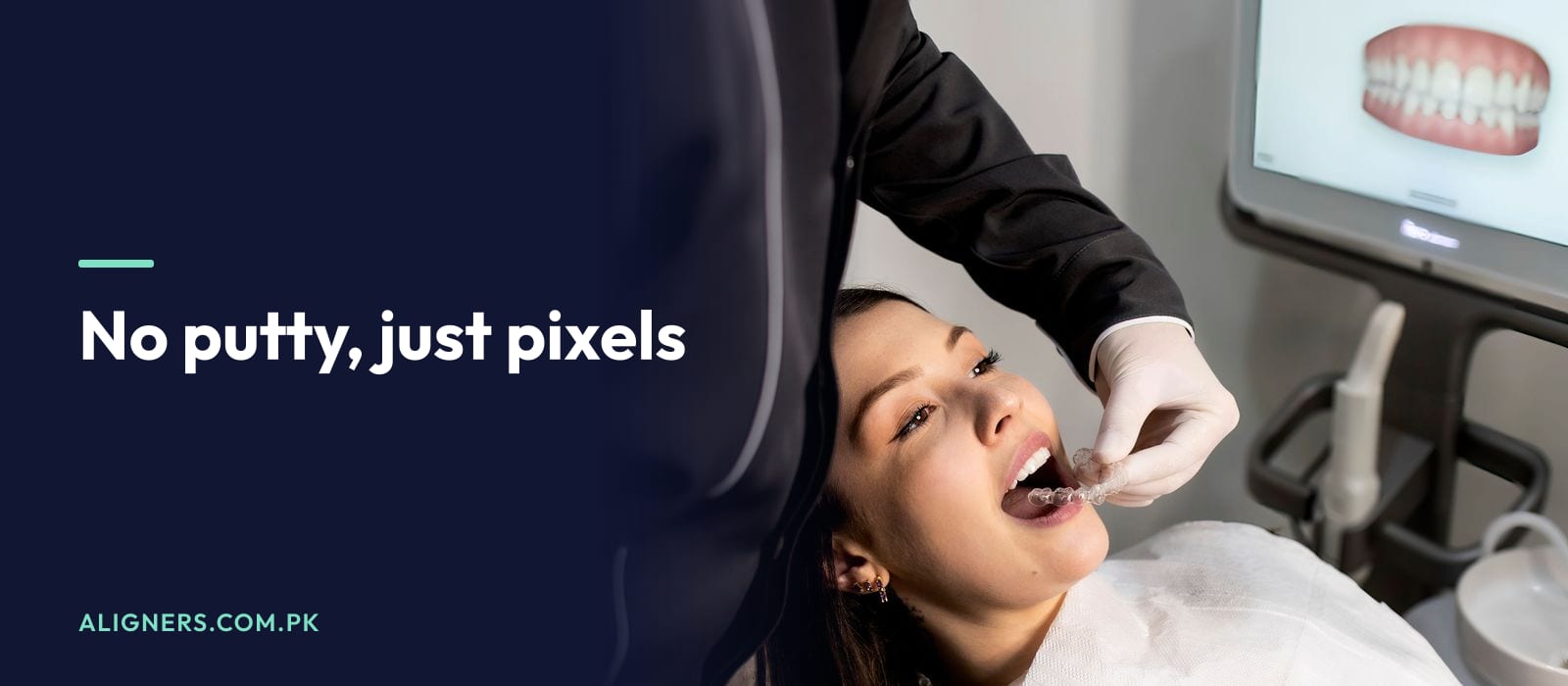
Disclosure: Aligners.com.pk is affiliated with ClearPath Orthodontics, maker of ClearPath Aligners. How we work.
If you have ever had a dental impression taken the old way, you may remember a tray full of thick, cold putty pressed into your mouth while you tried not to gag. For many people, that memory is one of the least pleasant parts of visiting the dentist.
Today, many clinics use digital scanning instead. A small handheld wand captures your teeth and creates a 3D model on a screen within minutes. For clear aligner treatment in particular, this scan is often the starting point for the whole plan.
This guide explains what an intraoral scan is, what happens during one, how it compares with traditional impressions and how the scan is used to plan aligners.
What is an intraoral scan?
An intraoral scanner is a small device about the size of a thick pen or electric toothbrush. It has a camera tip that is moved slowly around your mouth. As it moves, it takes thousands of images of your teeth and gums.
Software then stitches these images together to build a detailed three-dimensional model. You can often watch it appear on a screen as the scan progresses, which many people find quite interesting.
The scanner uses light to capture images. It is not an X-ray, so a scan on its own does not involve radiation. Your provider may still take X-rays separately to check roots and bone, as these show things a surface scan cannot.
What happens during the scan?
The process is usually simple. A typical appointment might go like this:
- Preparation. Your teeth may be gently dried with air, as saliva can affect image quality. You might be given cheek retractors to hold your lips back.
- Scanning the upper teeth. The wand is moved around the biting surfaces, the outer side and the inner side of each tooth.
- Scanning the lower teeth. The same process is repeated for the lower arch.
- Bite scan. You bite together normally while the scanner records how your upper and lower teeth meet.
- Checking the model. The operator reviews the 3D model on screen and rescans any area that has gaps or blurry spots.
The whole process commonly takes somewhere around 10 to 20 minutes, though this varies with the scanner, the operator and your mouth. You can usually breathe and swallow normally, and the operator can pause if you need a break.
Is it comfortable?
Most people find digital scanning more comfortable than putty impressions. There is no material filling your mouth, so the gag reflex is less likely to be triggered. You may feel:
- Mild stretching from keeping your mouth open
- A slight warmth or pressure as the tip touches your teeth
- Some jaw tiredness if the scan takes a while
If you have a strong gag reflex, a sensitive jaw or anxiety about dental visits, tell the team beforehand. They can take breaks and explain each step. Many people say it feels a bit like a long dental check-up rather than anything unpleasant.
Digital scans vs putty impressions
Both methods have been used successfully to make aligners and other appliances. Here is a general comparison:
| Digital scan | Putty impression | |
|---|---|---|
| What goes in your mouth | A small camera wand | A tray of soft material that sets |
| Gag reflex | Usually less of an issue | More likely for some people |
| Seeing results | 3D model on screen straight away | Model made later from the mould |
| Retakes | Specific areas can be rescanned | Usually the whole impression is redone |
| Sending to the lab | Sent digitally | Physical mould is sent or poured into a model |
Impressions are still a valid option and are used by many providers. Some clinics may not have a scanner, and some situations may suit impressions better. What matters most is that the record is accurate and taken by a trained team.
How the scan is used to plan aligners
The scan is not just a picture. It becomes the foundation of your treatment plan.
Creating your digital model
Your provider combines the scan with photos, X-rays and clinical notes. Together these give a full picture of your teeth, bite and gum health.
Planning the movements
Using specialist software, the provider maps out how each tooth should move from its current position to the planned final position. The total movement is divided into small steps, with one aligner for each stage. To understand the biology behind this, read how clear aligners move teeth.
Placing attachments and planning space
The digital model helps decide where attachments might go and whether space needs to be created, for example in cases of crowded teeth. Learn more in clear aligner attachments explained.
Previewing the result
Many systems produce an animation showing how the teeth are expected to move. This can be a helpful way to understand your plan. However, it is a planning tool, not a promise. Real teeth do not always move exactly as the software predicts, and adjustments are sometimes needed along the way. Our guide to refinements explains this.
Making the trays
Once the plan is approved, the aligners are manufactured from the digital models of each stage.
Will I need more than one scan?
Often, yes. Providers may take new scans:
- At the start of treatment
- If teeth are not tracking and a refinement is needed
- At the end of treatment to make retainers. See retainers after clear aligners
Tips before your scan appointment
- Brush and floss beforehand so the scanner captures clean tooth surfaces.
- Avoid a heavy meal right before, especially if you are prone to gagging.
- Wear lip balm, since your lips may feel dry from being held open.
- Ask questions. A good provider is happy to show you the model and explain what they see.
The bottom line
A digital intraoral scan is a quick, generally comfortable way to record the shape of your teeth. It often replaces putty impressions and provides a detailed 3D model your provider uses to plan aligner treatment step by step. The scan is one part of a full assessment, which should always be carried out by a qualified dentist or orthodontist.
To learn more, read our guides to clear aligners and aligners vs braces, or see what to expect in your first week with clear aligners. For general information on orthodontic treatment, visit the MouthHealthy orthodontics page.


